Discover one of the many Deities Wizards, witches, and more call upon
Hekate, often depicted at the crossroads and holding twin torches, was revered in ancient Greece as a powerful goddess of magic, the moon, and the spirit world. In historical accounts, she was believed to guard thresholds and guide souls through the realms of life and death. Temples and shrines dedicated to Hekate frequently stood at city gates or boundary lines, where offerings of food—known as “Hekate’s Suppers”—were left to gain her favor. Her triple form symbolized her dominion over the earth, sea, and sky, and even the legendary witches of Thessaly called on her name in incantations, highlighting her deep connection to sorcery and the occult arts.
Wizards and witches call upon Hekate today, they invoke her ancient authority to navigate dark mysteries and hidden realms of magic. By lighting torches at crossroads—both literal and metaphorical—they seek her guidance when facing pivotal choices or attempting to pierce the veils between worlds. Invocations to Hekate might involve offerings of honey cakes or incense, hoping to secure her blessing in rituals of divination and spells of protection. In return, Hekate lends her wisdom as a guide through spiritual transformations, protects them from malicious spirits, and emboldens their magical workings with the primal power of the night and the moon. Through her, these sorcerers harness a lineage of occult knowledge that reaches back to the earliest days of Greek civilization.
pre-7th century bce
Caria, Southwest Anatolia
Hekate’s cult originated in Caria (southwestern Anatolia), where she was especially prominent at Lagina. Cultic practice may predate Greek literary mention, but firm evidence for Bronze Age or early Iron Age worship is not conclusive—this period remains speculative.
8th to 6th century bce
Hesiod’s Theogony
Earliest literary reference to Hekate (lines 411–452). Hesiod praises Hekate, noting she is honored by Zeus above many other deities. Hesiod praises Hekate, noting she is honored by Zeus above many other deities. Depicts her as a benevolent goddess presiding over victories in war, success in daily affairs, and the well-being of children. Hekate will also spread to mainland Greece.
5th to 4th century bce
Classical Period, athens
Household Worship: Hekate starts to gain association with liminal spaces (doorways, crossroads) and the underworld—though this emphasis becomes more pronounced in later periods. In some regions, small statues (Hekataion) stood outside homes or at intersections for protection against evil spirits or misfortune. By the 5th century BCE, Hekate appears in works by tragic playwrights and other authors (e.g., Sophocles, Euripides).
323-31 bce
hellenistic period
Temple of Hekate at Lagina flourishes, becoming one of her most significant sanctuaries. Large-scale festivals (Hekatesia) and processions honor her; inscriptions attest to her popularity in Caria and beyond. With the conquests of Alexander the Great and subsequent cultural blending, Hekate’s attributes merge with local deities (e.g., with Egyptian, Phoenician, or other regional goddesses). Hellenistic philosophers and magicians begin exploring her chthonic (underworld) aspects, linking her to witchcraft, magic, and necromancy.
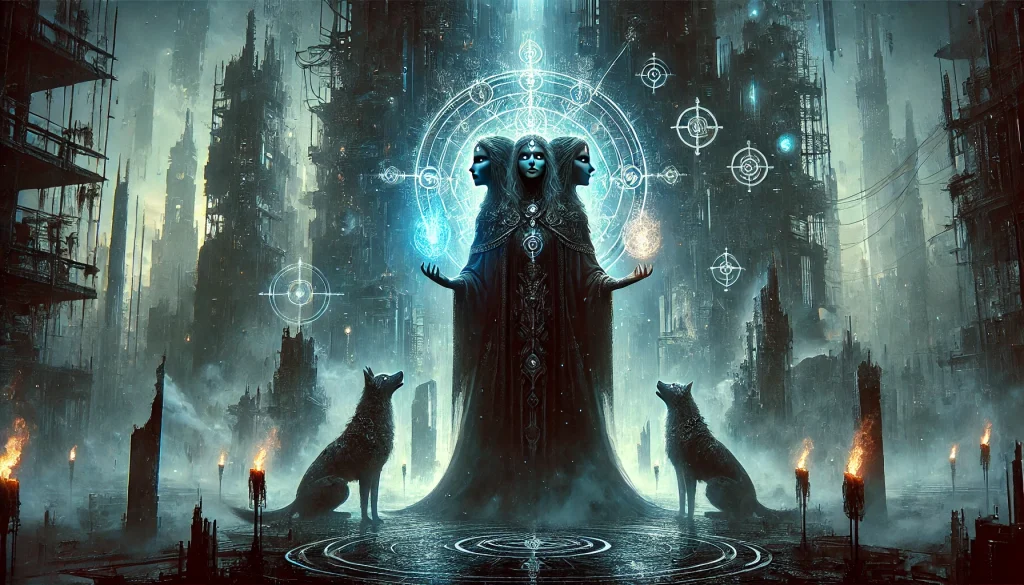
the torch bearer, the night going one, the mother, the maiden, the crone: Hekate.
31 bce-4th century ce
roman period
The Greek Magical Papyri (c. 2nd century BCE–5th century CE, though many of the texts date mainly from the Roman Imperial period) contain spells and invocations to Hekate, reflecting her pervasive role in magic and the occult. Hekate’s cult reaches one of its peak popularities in the broader Greco-Roman world during the Hellenistic and early Roman periods, when her temples, festivals, and magical associations spread throughout the Mediterranean.
late antiquity & middle ages
Christianization
As Christianity gains dominance, public temples to pagan gods are often closed or repurposed. Hekate’s reputation as a goddess connected with magic and witchcraft leads to a demonization of her cult in some Christian writings. Rural or “folk” practices sometimes continue to venerate Hekate in secret, especially in areas with lingering pagan traditions.
Medieval & Renaissance Europe
literary remnants
Hekate appears in literary works as a figure associated with ghosts, witches, and the night (e.g., in certain medieval grimoires or references in Renaissance occult texts). Over time, “Hecate” becomes synonymous with witchcraft or the supernatural, further codified in later folklore and dramatic literature (e.g., Shakespeare’s Macbeth).
Modern Revival
Occultism
Hekate reemerges as a mysterious, moonlit figure in poetry and art. Esoteric societies and occult revival movements (e.g., the Hermetic Order of the Golden Dawn) occasionally reference her in ritual contexts. Wicca (founded in the mid-20th century by Gerald Gardner) and various branches of Neopaganism embrace Hekate as a Crone Goddess or Triple Moon Goddess, emphasizing her roles in magic, liminality, and transitions (birth, life, death). Hekate is often invoked in rituals for protection, banishing, divination, and empowerment.
“Witchcraft, sorcery, divination, and magic are ancient and universal. Every culture, primitive or civilized, East and West, has had its share or magicians, sorcerers, and witches.“
– Kenneth Boa